
“I Had to Start All Over Again”: A Patient’s Remarkable Recovery After a Devastating Spinal Cord Injury
By Carla Palmer
In 2021, Sherika Green’s life was turned upside down.
First, her son was killed. Just two months later, her father died from cancer. The overwhelming grief took a physical toll. One day, while preparing food at home, Green became dizzy and fell, hitting the ground and suffering a cervical spinal cord injury.
“I hit a main vein,” Green said. “It caused me to need surgery, I couldn’t do anything.”
She was rushed to Jackson North Medical Center and quickly transferred to Jackson Memorial Hospital, where doctors determined she had severe spinal cord compression caused by a badly slipped disc in her neck that was pressing on nerves.
According to Stephen Burks, MD, the neurosurgeon who treated Green, the injury was among the most serious he’s encountered.
“Cervical spinal cord injuries are life-changing,” Dr. Burks said. “These are the types of injuries that can leave people dependent on others for the rest of their lives.”
Imaging revealed that she had both a traumatic disc herniation and a pre-existing condition known as congenital spinal canal stenosis — meaning her spinal canal was narrower than average, leaving her spinal cord with little room to tolerate injury.
“The fall essentially uncovered something that was already there,” Dr. Burks explained. “The cord got pinched and bruised.”
Because of the seriousness of the injury and the loss of movement in Green’s arms and legs, the surgical team moved quickly.
“We took her to the operating room right away,” Dr. Burks said. “She had almost no movement below the level of the injury at that time.”
Dr. Burks performed a two-stage operation, first removing the damaged disc from the front of the neck and then stabilizing the spine from the back to give the spinal cord as much room as possible to heal.
When Green woke up after surgery, her future was still uncertain. She could barely move her arms and had no movement in her legs.
“I couldn’t eat. I couldn’t feed myself. I couldn’t use the bathroom. I couldn’t put on my clothes,” she said. “I had to start all over again.”
She spent time in the ICU before transitioning to inpatient rehabilitation at Christine E. Lynn Rehabilitation Center for The Miami Project to Cure Paralysis at UHealth/Jackson Memorial.
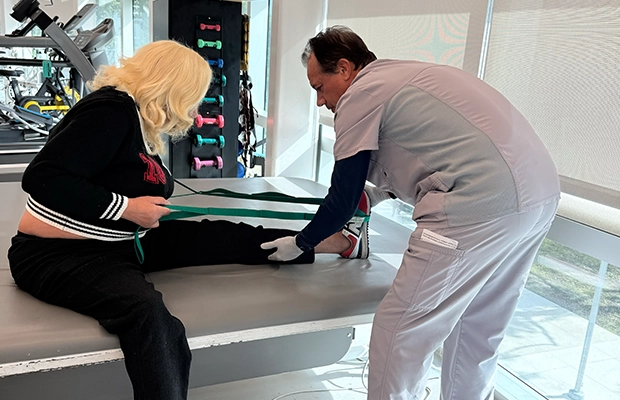
“At the beginning, she couldn’t walk, she couldn’t transfer, she couldn’t get out of bed,” said Pedro Pozzobon, the physical therapist who continues to work with Green today. “She couldn’t function at all.”
Emotionally, Green was at her lowest.
“I wanted to give up,” she said. “I didn’t think I was going to be here.”
But something kept pushing her forward.
“Some kind of way, God came to me and said, ‘Don’t give up,’” Green recalled. “And the people at Lynn, at Jackson — they helped me. I fought and fought.”
Recovery from a cervical spinal cord injury is never guaranteed. Even months after surgery, doctors often can’t predict how much function a patient will regain.
“Time is a huge factor,” Dr. Burks said. “When we last saw her before rehab, she could barely move anything. It’s difficult to know at that point how much recovery someone will have.”
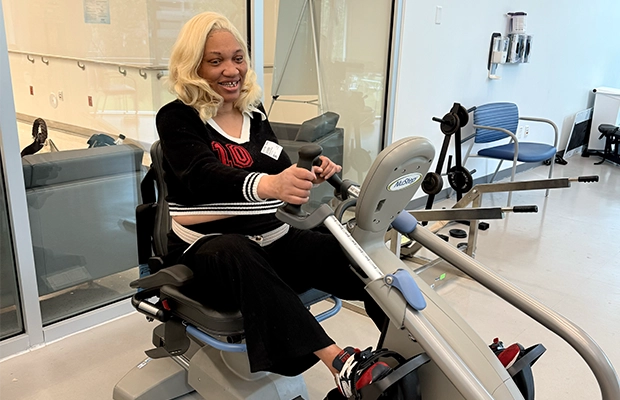
Through months of intensive therapy, Green slowly began to regain strength and mobility.
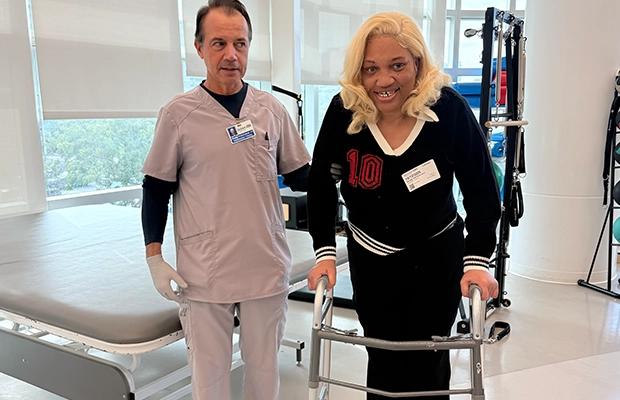
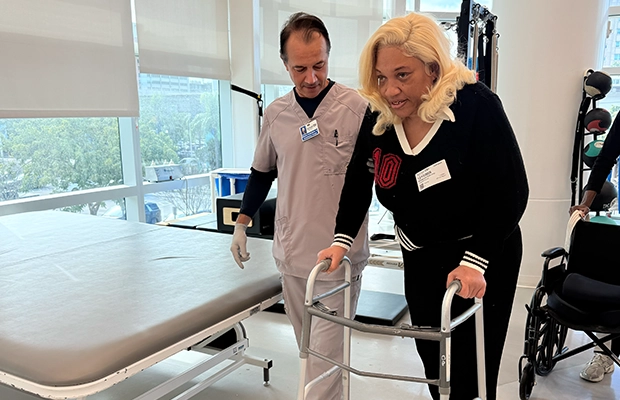
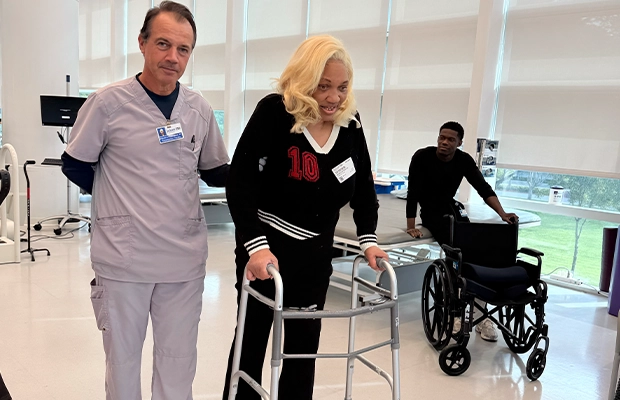
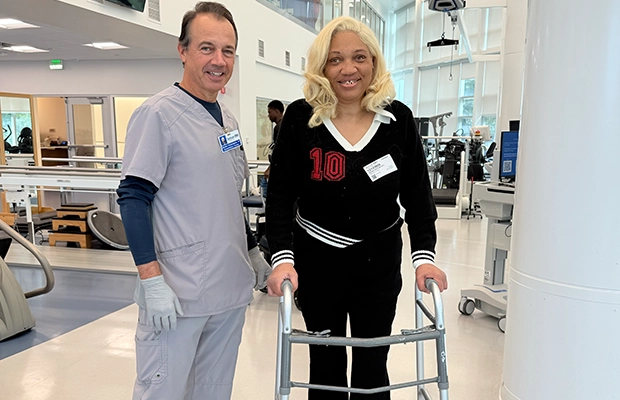
“She’s improved a lot,” Pozzobon said. “She regained strength, balance, and independence. Now she’s walking inside her home and managing most things on her own.”
Her therapy now focuses on leg strengthening, flexibility, posture, and stability. Although the exercises are often painful and exhausting, Green never skips the work.
“She does everything we ask her to do,” Pozzobon said. “She understands that the exercises are what help her get better.”
Today, Green attends outpatient therapy once a week and follows a home exercise program. While she has a wheelchair for long distances, she prefers to walk whenever possible.
“I don’t use the electric chair,” she said. “Because I want to get up. I have to do it for myself.”
Now 53, Green lives in Liberty City with one of her two daughters and is a proud grandmother to six grandchildren. That close-knit family support has been central to her recovery.
She can now cook, clean, dress herself, and use the bathroom independently — milestones doctors once thought unlikely.
“Things they told me I wouldn’t be able to do, I’m doing them,” she said.
Inspired by her journey, Green has begun writing a book centered on the words that carried her through her darkest moments: never give up.
“It’s going to get hard before it gets better,” she said. “But you’re going to get there. Just never give up.”
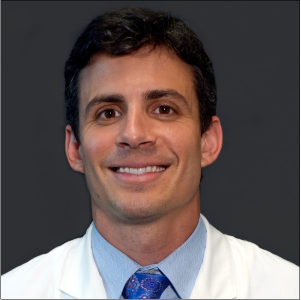
Stephen Burks, MD
Neurological Surgery
Jackson Memorial Hospital
1611 N.W. 12th Avenue Miami, Florida 33136
UHealth at Boca Raton
3848 FAU Boulevard Suite 305, Boca Raton, Florida 33431
University of Miami Health System
1475 NW 12th Avenue Floor 1, Miami, Florida 33136
University of Miami Health System
1295 NW 14th Street Suite 1700, Miami, Florida 33125