
Young Woman Overcomes Paralysis with Therapy at Lynn Rehabilitation Center After Suffering Attacks From Rare Metabolic Disease

By: Krysten Brenlla
For 21 years, Maria Paula Iniguez, now 23, lived a normal life.
However, Iniguez’s life suddenly took a turn in 2021 when she started feeling extreme abdominal pain.
“One day, the stomach pains were so bad that I had to rush to the emergency room,” she said. “They found an ovarian cyst the size of an orange and told me that was what was causing my pain.”
Iniguez’s doctors advised her that she needed surgery to remove the ovarian cyst, and that her pain should subside afterward.
Nevertheless, her abdominal pain got worse.
“I had a trip planned to Ecuador three days after the surgery. When I arrived, I saw my doctors because the stomach pain I was feeling was excruciating,” Iniguez continued. “They ran a bunch of tests and ultrasounds to see if something had gone wrong with the ovarian cyst removal surgery, but they couldn’t find anything, so they gave me pain medication to help – that’s when everything went wrong.”
A few days after she was prescribed the medication, Iniguez suffered a seizure. Her family rushed her back to the hospital in Ecuador.
Upon arrival, Iniguez’s doctors placed her in a medically induced coma for three days to stop the seizures so they could run tests to find a potential diagnosis.
When she woke up, she started hallucinating and losing motor function throughout her entire body.
“I didn’t even know that I was in the hospital; I was hallucinating that entire time,” Iniguez said. “On top of that, my blood pressure was skyrocketing, my heart was beating at 140 beats per minute, and I started to become paralyzed – all of this was happening while my doctors were running tests to figure out what was wrong with me.”
The symptoms Iniguez was experiencing – severe abdominal pain, nausea, seizures, hallucinations, and loss of motor function – all led her doctors toward a potential rare diagnosis.
They thought Iniguez was suffering extreme attacks from acute intermittent porphyria, a rare metabolic disorder that mainly affects the nervous system in five to six people for every million in a population. The disease is characterized by a partial deficiency of an enzyme called porphobilinogen deaminase, the third step in the path to produce heme, which is essential in the function of proteins such as hemoglobin.
Even though the doctors reached a potential diagnosis, they did not have the proper resources in any hospital in Ecuador to confirm it. Additionally, the hospital could not afford the treatments that were necessary to stop the attacks.
Racing against the clock, doctors advised Iniguez’s family to fly back to the United States in an air ambulance to confirm their diagnosis and receive treatment – if not, she could die.
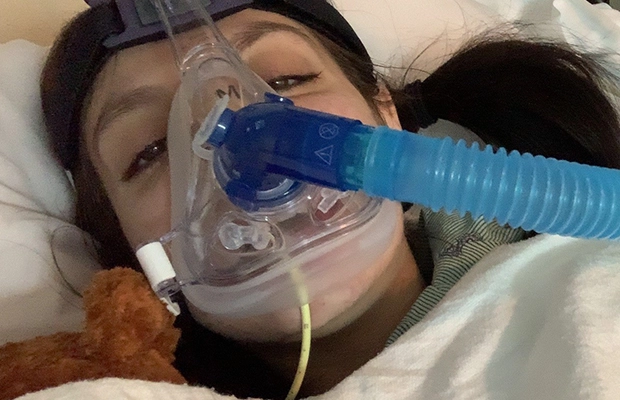
“At that point, I was intubated and really didn’t know what was going on,” she said. “When my hallucinations finally stopped, I woke up completely paralyzed, with my family and doctors saying, ‘We need to get Maria to Miami.’”
Once she was back in the U.S., Iniguez was rushed to Jackson Memorial Hospital, where she met Cynthia Levy, MD, a hepatology specialist at Jackson Memorial and UHealth – University of Miami Health System, for life-saving treatment.
“Acute intermittent porphyria is one of the four types of porphyria that present with neurovisceral symptoms and acute pain attacks,” Dr. Levy said. “Most patients present with symptoms that evolve over hours and can last for days if left untreated, often with abdominal pain associated with fast heart beats and high blood pressure. Neurological symptoms like tingling, numbness, and muscle weakness are common, and in rare cases, like Maria’s, muscle weakness is so severe it can cause paralysis. Low sodium levels, seizures, hallucinations, and altered mental activity can also occur.”
To stop the attacks, Iniguez needed several treatments of hemin, an IV treatment that replenishes the heme pool and slows down the body’s production of new heme, which suppresses the production of toxic porphyrins. Dr. Levy’s team found that Iniguez’s attacks were likely triggered by a combination of factors: her recent use of birth control pills, surgery, and possibly an increase in alcohol consumption.
“Maria’s doctors in Ecuador recognized the combination of abdominal pain with neurological symptoms in a young woman, which point toward this disease, and they were able to act quickly in transferring her to Jackson for life-saving treatment,” Dr. Levy continued. “Maria is extremely lucky.”
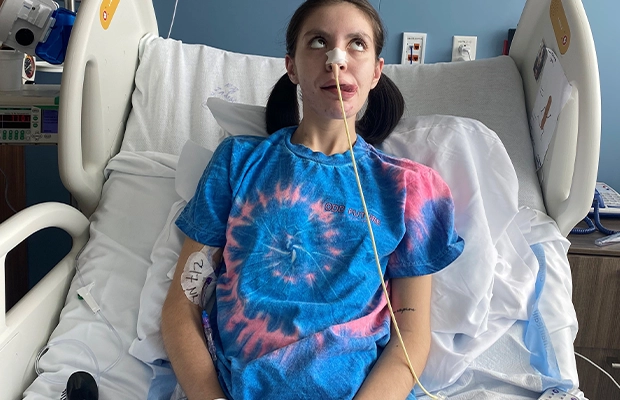
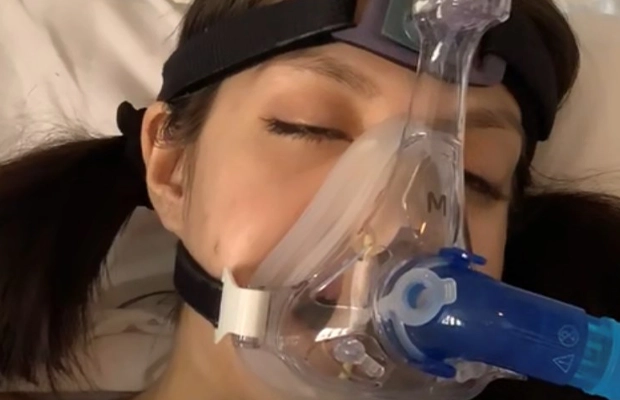
After 14 days of hemin treatment in the intensive care unit (ICU) at Jackson Memorial, Iniguez’s paralysis showed signs of improvement. Additionally, she slowly regained the ability to breath on her own.
However, her journey was far from over – the attacks had rendered her paralyzed for months, resulting in significant motor deficits.
“While I was in the ICU, I went into respiratory distress and had to be intubated the entire three weeks I was there,” Iniguez said. “When they removed the tube, I stepped down to intermediate care and began rehabilitation therapy as an inpatient – that was the most challenging part.”
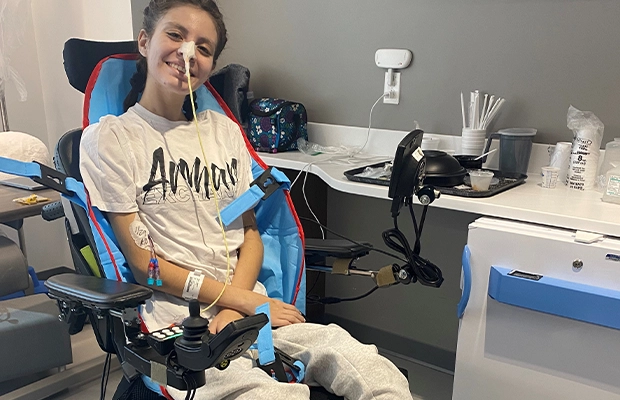
Iniguez stayed at Jackson Memorial for more than a month, and received intense inpatient rehabilitation therapy that included physical, occupational, and speech therapy at Christine E. Lynn Rehabilitation Center for The Miami Project to Cure Paralysis at UHealth/Jackson Memorial.
“When Maria was admitted into our inpatient rehabilitation program, she was essentially a flaccid quadriplegic,” said Lauren Shapiro, MD, medical director of stroke rehabilitation services at Lynn Rehabilitation Center. “Initially, it was challenging to get her out of bed, and she had to relearn how to dress herself, feed herself, shower, and use the restroom on her own.”
Despite the challenges, after several weeks of rehabilitation therapy in the hospital, Iniguez began to hit several major milestones, like bending and moving her legs and arms on her own.
She was discharged in February 2021, but still required intense outpatient rehabilitation therapy.
After just two months, Iniguez began to take her first steps.
“Maria was extraordinarily determined, and in my 15 years as a rehabilitation physician, this is the first and most extreme case of acute porphyria that I’ve encountered,” Dr. Shapiro said. “She worked through the pain and stuck with her therapy, which is why she’s had such a great outcome.”
Iniguez did not fully regain her mobility until two years later.
“What took me the longest to regain was the mobility in my hands,” Iniguez said. “I could do everything else except use my hands, so when I finally started feeling my hands again – it felt amazing just to hold a pencil and a fork, or just to do my own makeup.”
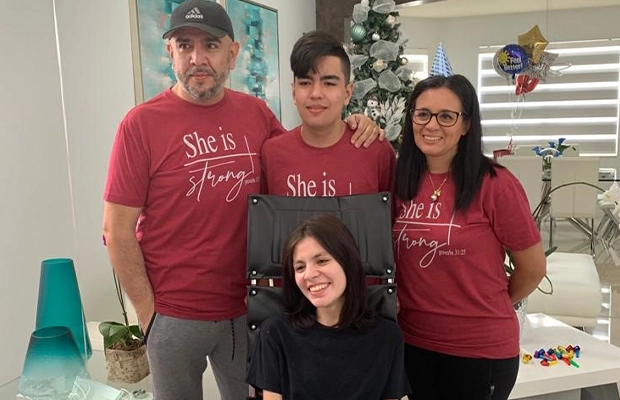
Today, Iniguez lives a completely normal and independent life, and continues to follow up with Dr. Levy to monitor her liver and kidney functions, which could be affected by the disease.
Dr. Levy and her team transitioned Iniguez from weekly hemin infusions to monthly givosiran injections, which are administered under the skin, to prevent recurrent attacks.
“It’s important for physicians to know and understand what this rare disease is, when to suspect if a patient is suffering an attack (or attacks) from it, and how to diagnose it,” Dr. Levy said.
For the future, Iniguez plans to return to school at the University of Central Florida, and credits her renewed health to the doctors and therapists who ultimately saved her life – both in Ecuador and at Jackson Memorial.
“I think I had the best team of doctors to treat me,” Iniguez said.
“I am so grateful to everyone at Jackson for giving me my life back.”

Cynthia Levy, MD
Gastroenterology, Transplant Hepatology
Cynthia Levy
1475 NW 12 Ave Miami, Florida 33136